My
Book Review Disclaimer: I am not going to waste my time or your time
by writing a review about a book that stinks. Likewise, I am only going
to bother reading it if it's not a waste of time and I am learning from
it. If it's good and I think it's a worthwhile read, I'll put it up on
here and tell you why.
-----------------------------------------------------------------------------------------------------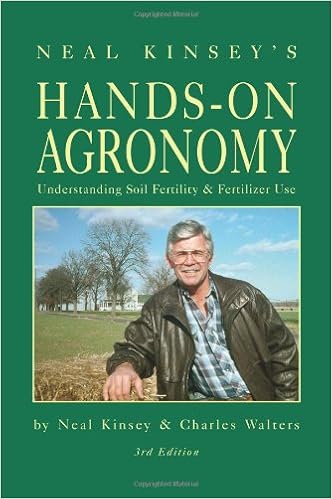 |
| If you see this at a garage sale, get it! |
Well I have to be honest and tell you that I am not going to do this book justice. While this book was a great resource and taught me a lot, I don't remember as much as I wish! So that said, let me throw some things out that I do happen to remember.
Get a soil analysis done on your property!
Any questions? Well there should be... you also need to consider what lab you have do the test. For me, I paid $16 to have the local agricultural extension office do my analysis... which was a mistake! How could that be a mistake? Well the basic test was only $12, but I wanted more details, so I paid a few dollars extra. What did I get out of it? Well I got my basic soil analysis with a few extra details that probably won't help me. The problem is that I was hoping to figure out what the boron levels were in my garden, and the extra special test that I pad extra for didn't include it! Sorry for the rabbit trail, but make sure you are going to get out of the soil analysis what you think you are going to get! For general garden testing, maybe it was good enough... but next time I'm getting my soil analyzed by Logan Labs. Oh, once you start using these things, try to stick with the same lab... there are different methods that give different results... don't chase different results just because it's a different lab!
Okay, back to the book...
Let's start off talking about the author. Neal Kinsey went to school in Missouri and you can find his company here and he has a great Q & A page here. While in school he was quite fortunate to study under a guy name Albrecht (Wikipedia has an article on him), who was something of a pioneer of logic and (un)common sense and had a profound impact on who Neal became.
 |
| William Albrecht, one smart cookie! |
Albrecht was outspoken on matters of declining soil fertility, having
identified that it was due to a lack of organic material, major
elements, and trace minerals, and was thus responsible for poor crops
and in turn for pathological conditions in animals fed deficient foods
from such soils.[14]
He laid the blame as:
"NPK formulas, (nitrogen, phosphorus, potassium) as legislated and enforced by State Departments of Agriculture, mean malnutrition, attack by insects, bacteria and fungi, weed takeover, crop loss in dry weather, and general loss of mental acuity in the population, leading to degenerative metabolic disease and early death.[14]
Hopefully Wikipedia doesn't mind that quote, but I think it summarizes this book fairly well.
The book... remember the book?
From this book I took away a better understanding of how the elements in the soil effect how things grow. Similar to Soil, Grass & Cancer (see my post on it here - it talked mostly about livestock and humans), this goes into detail about how the crop yields are impacted by the soil elements. The big take away for me was that the calcium levels in the soil need to be 60-70% saturation and the magnesium needs to be 10-20% saturation. Saturation?
Cation Exchange Capacity
Okay, another thing I learned about is called CEC, or cation exchange capacity. This measures the soils ability to hold onto the different elements. Think a garage for a moment. The more bays a garage has, the more cars it can hold. If you fill up your garage with Chevy's, there won't be any room for Ford's. That's fine if all you want is Chevy's, but that's not how the soil works. So the CEC is like how many bays your garage has, the more the better! If you only have one bay and you put a Ferrari in it, your Ferrari saturation is at 100%. If you have two bays and one Ferrari, your Ferrari base saturation is at 50%, and so forth. So when you measure the CEC for your soil, you naturally want larger numbers. The bigger the number, the more elements and nutrients the soil can hold onto without it leaching away with the rain and snow!
So we have the 60-70% calcium target (aim for 70% for clay soils) and 10-20% magnesium target (aim for 10% with clay soils - sand is the opposite) and the remaining 10% is made up of your fertilizer nutrients like Nitrogen, Potassium and Phosphorus, or NPK. BUT WAIT!!!! This is where things get interesting... if the N-P-K values are not in the right ratio's, you are going to have some issues still. If you put down too much phosphorus (think manure), weeds like bindweed will take over and thrive! (I think it's phosphorus...)
The Premise
If you get your soil balanced, you can grow the healthiest of whatever it is that you want to grow on your soil! If it is balanced, the PH will be near 7.0 and acid loving plants wont care... they'll still grow healthier on this balanced soil than anywhere else.
My take away, get my soil balanced. If I can find the time to throw up my soil analysis, I'll try to talk through it and explain it better... but at the end of the day, I need about 4ton of calcium per acre... which is a lot! My calcium saturation is at 35% when the target is 70%... hopefully I'll be able to grow healthy tomatoes, squash and pumpkins if I get that fixed... because it hasn't worked yet!
Okay, my lunch break is over... back to it! (I really need to buy this book and read it again...)

